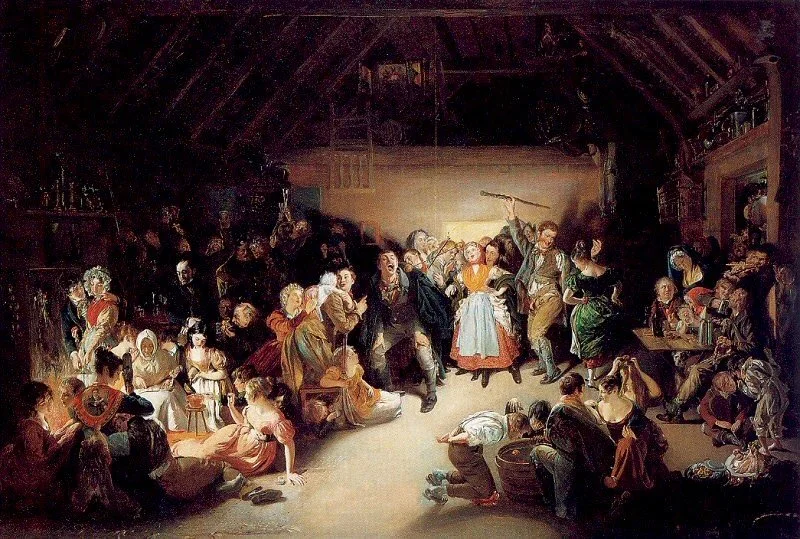
The theme of our lecture at the Lalor Centre on Tuesday 27 October 2026 was a seasonal one: The Irish Hallowe’en Experience. Our speaker, artist and folklorist Michael Fortune provided us with fascinating insights into how Hallowe’en was traditionally celebrated in Ireland. We learned of how families prepared colcannon, made from mashed potatoes and cabbage or kale, and barmbrack. Rings, coins and other objects were hidden in the food to predict marriage, wealth or other events in the coming year. Hallowe’en was a liminal time when the days were shortening and the dark nights of winter beginning.
Michael told us about guising, known in parts of Wexford as collicking, when people disguised themselves with masks, old clothing and covered hands and then visited neighbours who tried to guess their identity. The purpose was to remain unrecognisable, not to dress as a particular character. Adults participated as well as children. Such activities were also called guggying, vizzarding or going out as pookies. In some counties a bit of devilment was practiced in the form gate-lifting. Home-made lanterns were traditionally made of turnips, carved with grotesque faces. Traditional games were often focused on fortune telling for the year ahead. Of course Hallowe’en was also associated with the night when spirits roamed about, and the original rationale for dressing up was to blend in with the wandering spirits.
Since the late 1990s Michael Fortune has been recording the stories, voices, and lived traditions of different people who have made their homes in Ireland. His publications include The Folklore of Wexford, Vols. 1 & 2 and The May Bush in Co. Wexford. “There have only been a few true pioneers in the field of folklore collection in Ireland — guardians, sacred recorders of our lore — who have collected and documented the treasures of folk tradition, and without doubt, Michael Fortune is one of them. In years to come, he will be regarded as Ireland’s Alan Lomax.” Manchán Magan.
Photo credit: Daniel MacLise Snap-Apple Night (1833). Public domain, courtesy of Wikimedia Commons.